When you can't see someone's face, tone collapses. Emojis aren't decorations in async communication—they're load-bearing infrastructure. Without them, your message is ambiguous. With them, it lands.
The research backs this up. Psychological studies show that people misread tone in written communication roughly 50% of the time when there are no prosodic cues—no voice inflection, no facial expression, no body language. Emojis restore those cues cheaply. A single character does the work that would otherwise require a paragraph of context-setting.
Three Jobs Emojis Do in Remote Work
Signal emotional register. Is this message enthusiastic? Sarcastic? Dead serious? A thumbs up means different things than a thumbs up followed by a smirk emoji. Emoji tell people whether they're supposed to laugh or act on something immediately.
Reduce ambiguity in short messages. "Sounds good 👍" and "sounds good" are technically the same words, but they land differently. The first is affirmative and positive. The second could be passive-aggressive or dismissive depending on context you can't see. Emoji collapse that interpretive gap.
Create social warmth. Text-only environments are cold. They cause burnout. Emoji inject personality back into asynchronous communication. A casual hello with a wave emoji isn't much, but it accumulates. Over weeks and months, servers that use emoji heavily report higher member retention and more active participation.
The Blob Cat Case Study
Take the Blob Cat emoji pack. Its range covers nearly every situation you'll encounter in a remote workplace.
:blob-cat-ThinkSmirk is for skepticism. "I'm listening but I have doubts." :blob-cat-CozyWave is a genuine, low-pressure greeting. :blob-cat-Heart signals actual warmth, not corporate politeness. :blob-cat-Sad is real commiseration—"that sucks and I get why you're frustrated." :blob-cat-Bongo is pure celebration.


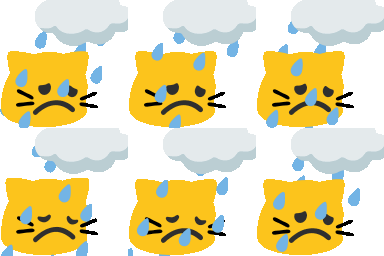


This isn't frivolous. This is social infrastructure. A team that has emoji like this feels human. A team that doesn't feels like a corporate transmission.
Code Review and Async Approvals
Engineering teams discovered something specific: code review culture benefits massively from emoji. The LGTM pack (Looks Good To Me) exists because developers needed a faster, warmer way to approve pull requests.
:lgtm: in a PR comment communicates approval, confidence, and camaraderie in a single reaction. Typing "approved" is cold. Typing "approved looks good" is repetitive. A custom LGTM emoji signals competence and good vibes simultaneously. It's become industry standard in some circles because it works.


The Numbers Don't Lie
GitHub, Slack, and Notion all tracked emoji usage during the 2020 remote work pivot. Across all three platforms, emoji reactions spiked 200% or higher in the first three months of mandatory work-from-home. That wasn't a coincidence. It wasn't frivolity. It was necessary communication.
People were desperate to restore tone to text. Emoji solved it.
The companies that recognized this and invested in their own custom emoji sets saw even higher engagement. Slack workspace admins who built quality emoji packs reported that usage of those emoji outpaced default emoji by a factor of five within a month.
What Happens Without Emoji
Try an experiment. Spend a week in a professional Slack or Teams workspace that disables custom emoji and sticks to defaults. Notice how the conversation feels different. More formal. Less collaborative. More transactional.
Now switch to a space with rich custom emoji. The same people have different conversations. They're looser. They laugh more. They're actually bonding through the text.
That's not superficial. That's the difference between a workspace where people tolerate being and one where people actually want to show up.