Emoji design has gotten more sophisticated every year. 2023 had clear visual language. 2024 pushed animation. 2026 has distinct trends that separate the thoughtful emoji from the lazy ones. Here's what's actually changing.
Trend 1: 3D and Dimensional Animation
Among Us started as flat 2D crewmates. The current emoji pack has full 3D animated versions with lighting, shadows, and depth. Baby Yoda in the Star Wars pack has dimensional depth that reads even at 64×64.
The technology to render 3D-looking emoji at small file sizes has become accessible. You don't need a render farm. You can build dimensional emoji in Blender, optimize it as a GIF, and it's live. More emoji creators are doing this intentionally now.
The trend is clear: emoji that feel flat are starting to feel outdated. Expect dimensional animation to become standard by 2027.



Trend 2: The Long Loop / Narrative GIF
Old GIF emoji were 3-4 frames. Simple bounce, simple loop, minimal motion.
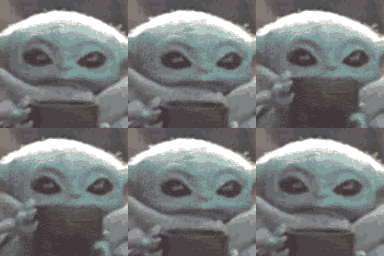
New emoji are 12-20 frames with actual storytelling. Baby Yoda drinking soup. Bowser laughing. The dancing banana doing a full routine. These aren't just reactions—they're mini-scenes.
The Kirby entrance emoji doesn't just sit there. It enters. The anticipation and punchline happen within the loop. Viewers see a beginning, middle, and end, then the loop resets and they're back at the beginning. It's engineered to stay engaging through multiple viewings.
This requires more thought in design. You can't just animate idle motion. You need a narrative arc in 20 frames or less. The creators doing this best are thinking about engagement, not just aesthetics.
Trend 3: IP Crossover Emojis
Dancing Banana Batman. Kirby with sunglasses. Among Us characters dressed as other game characters. The cross-IP mashup format is endemic now.
Every fandom community finds its own intersection with adjacent properties and makes an emoji from it. The technical barrier is lower (you can AI-assist on character design now). The cultural permission is higher (remix culture is normalized).
This is chaos in the best way. It means emoji design is less about polished singularity and more about community remix. More voices, more styles, more options. The diversity is real.
Trend 4: Emotional Specificity Over Generic
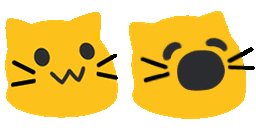
The generic thumbs up is losing ground to nuanced expressions. :blob-cat-ThinkSmirk: communicates something more specific than 👍. It says "I think this is clever but I'm not fully on board."
The trend is toward emoji sets that cover more emotional territory with more precision. Instead of one reaction emoji, communities are building 8-12 reaction emoji that cover agreement, disagreement, confusion, joy, suspicion, celebration. You can say more with less friction.
This is the inverse of the "bigger emoji library" trend. It's not about quantity. It's about precision of emotional expression. Fewer emoji, but better matched to actual sentiment.
Trend 5: Loopable Celebrations
The dancing banana, party parrot, Kirby clap—these share a structure: infinite loop, clear celebration signal, no beginning or end. They're engineered to live in a chat channel and feel alive.
They're not transitions. They're not intros/outros. They're pure celebration on repeat. More designs are being built this way intentionally. The engineering constraint is: can this loop forever without feeling like a repetition?



Trend 6: Meme Character Staying Power vs Flash-in-the-Pan
Among Us peaked in 2021. The emoji set is still in active use across Discord, Twitch, Slack. Baby Yoda debuted in 2019. Still going strong. Pepe is over 15 years old and growing.
Contrast with characters that peaked and vanished completely within a year.
What makes the difference: emotional versatility (the character can express multiple emotions and use cases) and community adoption (the community decided the character was worth keeping, not the company promoting it).
A character that only works for one joke doesn't survive. A character that can be applied to multiple contexts and carries cultural weight—that stays.
What to Watch in 2026-27
AI-generated custom emoji is maturing fast. You describe what you want ("a dancing robot wearing a crown"), the tool generates it, you refine it, it's live. Personalized emoji generation at consumer price points will become standard.
This sounds disruptive to designer emoji creators. In practice, it creates more demand for customization. The bottleneck shifts from "can I make an emoji" to "which emoji matches my exact brand and vibe." More people will commission and customize.
The design trend is not consolidation. It's explosion. More variety, more precision, more options.
Get the most-used animated packs now while communities are deciding what their standards are. Start at emojicreator.ai/packs and explore what's already working at scale.